

According to the Australian Computer Society (ACS), the technology and engineering sectors in Australia are booming with rapid growth due to the rapid change in digitalisation, infrastructure development, and the thirst worldwide, which is seeking innovation. Whether it is cloud computing and cybersecurity or mining and data science, organisations throughout the country are fighting to secure the most talent with the appropriate technical skills and leadership.
The competition has also increased salaries to an exceptional high, making IT and engineering one of the highest-paying careers in the Australian labour market. You are a seasoned professional considering your next career, or you are a graduate and you are planning your future career, and it can be a strategic advantage to know which positions come with the best financial benefits.
In this article, we explore the top 10 highest-paying IT and engineering jobs in Australia, outlining what each role entails, why it’s in demand, and what qualifications or experience can help you reach the upper end of the pay scale.
🔑 Key Highlights
- Intensive digitalisation and infrastructure development are offering high-paying jobs around the country.
- CIOs and CISOs, as well as engineering directors, make an average of AUD 250,000-400,000 a year.
- Cloud computing, cybersecurity, artificial intelligence, and data science are the most rapidly expanding and in-demand areas.
- Talented professionals and foreign workers are able to take the best positions by using the migration and sponsorship schemes.
Table of Contents
List of Highest Paying IT and Engineering Jobs in Australia
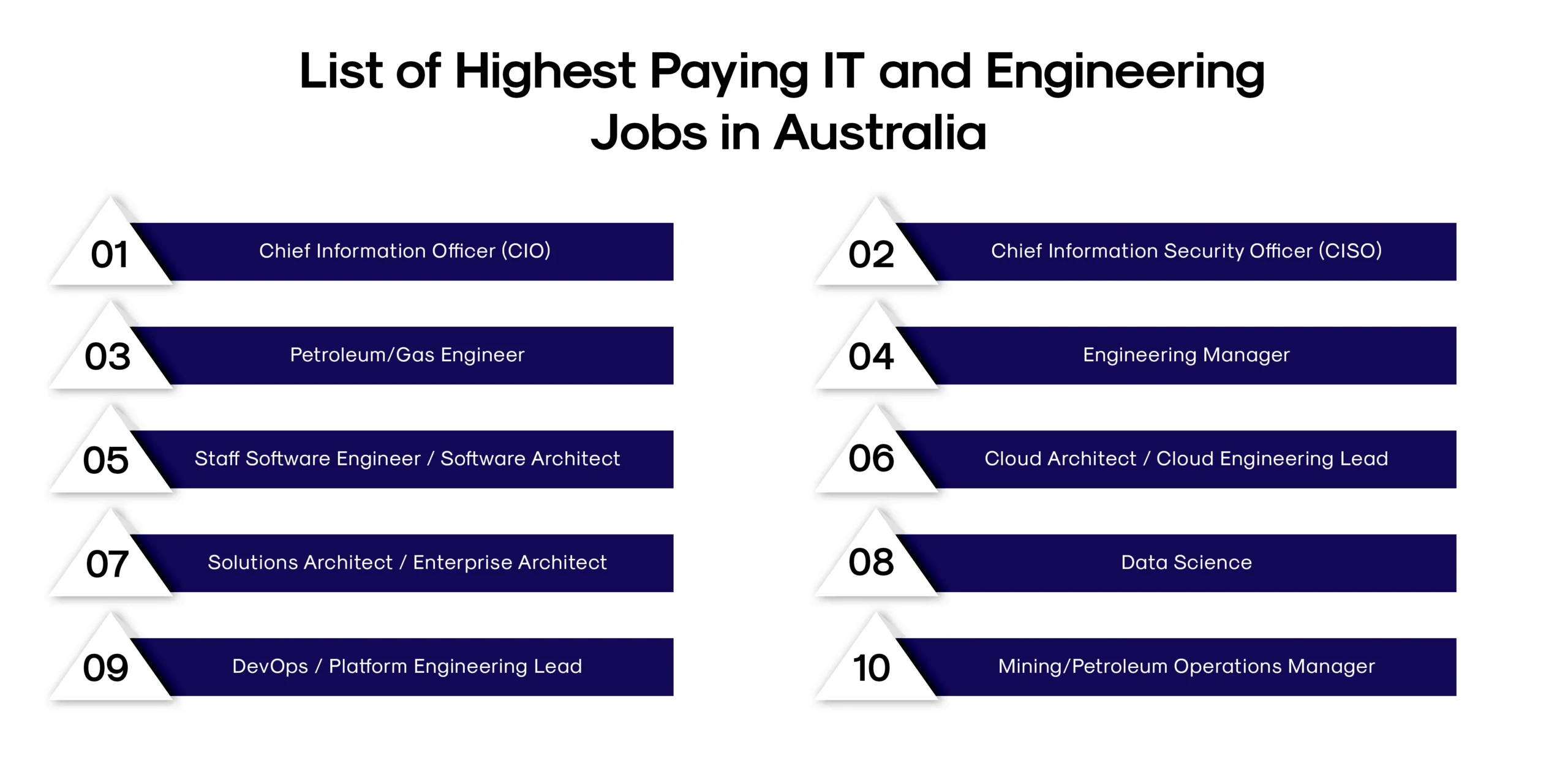
1. Chief Information Officer (CIO)
At the top of the IT salary pyramid sit the CIO and CTO, the strategic leaders responsible for steering a company’s technological vision. These executives fit business objectives to technology innovation, manage large budgets, and lead digital transformation programmes that determine the competitiveness of an organisation.
In Australia, CIOs and CTOs typically receive between AUD 220,000 and AUD 375,000 and above based on the size and industry of the company. They have specialised in areas such as leadership, digital strategy, and change management and are indispensable in the modern tech-driven business landscape.
2. Chief Information Security Officer (CISO)
The role of the Chief Information Security Officer has never been more important than ever before, based on the escalation of cyber threats and the sophistication of data breaches. CISOs formulate and implement security structures, coordinate incident response, and ensure adherence to strict laws on data protection.
CISOs are the most in-demand IT professionals in Australia, with salaries of between AUD 180,000 and $360,000+. Their ability to combine technical expertise with risk management skills renders them watchdogs of corporate trust and data integrity.
3. Petroleum/Gas Engineer
Australia’s thriving resources sector continues to pay premium wages to skilled petroleum and oil and gas engineers. These professionals design, develop, and optimise the processes involved in extracting and producing hydrocarbons efficiently and safely.
Experienced engineers in this field can expect salaries of AUD $140,000 to $220,000+, with additional benefits for those working in remote or offshore locations. Their work is crucial to maintaining the country’s energy output and global export competitiveness.
4. Engineering Manager
Complex industrial, infrastructure, and construction projects are created with the assistance of engineering managers. They provide multidisciplinary teams, guaranteeing safety and compliance, and provide large-scale engineering solutions on time and on budget.
Salaries are between AUD150,000 and $200,000+, with other performance bonuses on large projects. They are the main actors in the thriving infrastructure and resources industry in Australia due to their combination of leadership/technical supervision and project delivery capabilities.
5. Staff Software Engineer / Software Architect
Software engineers and software architects occupy senior technical roles, such as principal and staff software engineers, which influence the architecture and scalability of a software system in the present day. Such professionals develop the key platforms, performance optimisation and development team mentoring.
Their extensive technical expertise and ability to solve problems attract them an annual salary of AUD 140,000 to 220,000 plus. Their skill in balancing between innovation and reliability is very valued in the booming Australian tech ecosystem.
6. Cloud Architect / Cloud Engineering Lead
With cloud computing becoming the foundation of any digital infrastructure, leaders of cloud architecture and cloud engineering are essential to designing cloud environments that are highly secure and scalable, as well as economical.
They manage cloud migrations, infrastructure automation and integration of hybrid systems with salaries of between AUD $140,000 and $200,000 or more. Through their competency, organisations can modernise their operations and minimise their costs by making them competitive in the cloud-first world.
7. Solutions Architect / Enterprise Architect
Enterprise architects and solutions help to seal the divide between technology and business strategy implementation. They create massive IT systems, combine new platforms and ensure a free flow of cooperation between departments.
These positions attract remuneration of between AUD 140,000 and 250,000 in Australia, depending on the level of strategic value. Their capability to convert business objectives into technical roadmaps is important to businesses that are being digitally transformed.
8. Data Science
Data Science and Machine Learning Leads harness data to drive innovation, efficiency, and profitability. These professionals lead analytics and AI initiatives, helping companies make smarter decisions and build predictive systems.
They have good statistical, programming, and modelling skills that make their salaries AUD $140,000 to AUD $220,000+. With the rise in the reliance on data by businesses, the demand for knowledgeable data executives is sharply increasing in various sectors such as finance, healthcare and retail.
9. DevOps / Platform Engineering Lead
Platform engineering and heads of DevOps are vital in ensuring the efficiency, scalability, and reliability of the digital systems. They are automated, continuous integration and powerful infrastructure administration to streamline software delivery.
These professionals make AUD $130,000 to $200,000+ to ensure a smooth working relationship between the development and operation departments. The quality of their work has a direct effect on how an organisation can become innovative within very short timeframes and how the organisation can remain online with its systems.
10. Mining/Petroleum Operations Manager
Mining and petroleum operations managers oversee Australia’s lucrative resource extraction projects. They are responsible for ensuring production efficiency, safety, and environmental compliance in some of the nation’s most challenging operational environments.
With salaries reaching AUD $140,000 to $220,000+, these roles offer both high income and high responsibility. Their leadership ensures that Australia remains a global powerhouse in mining and energy production.
Fastest-Growing IT and Engineering Roles in Australia
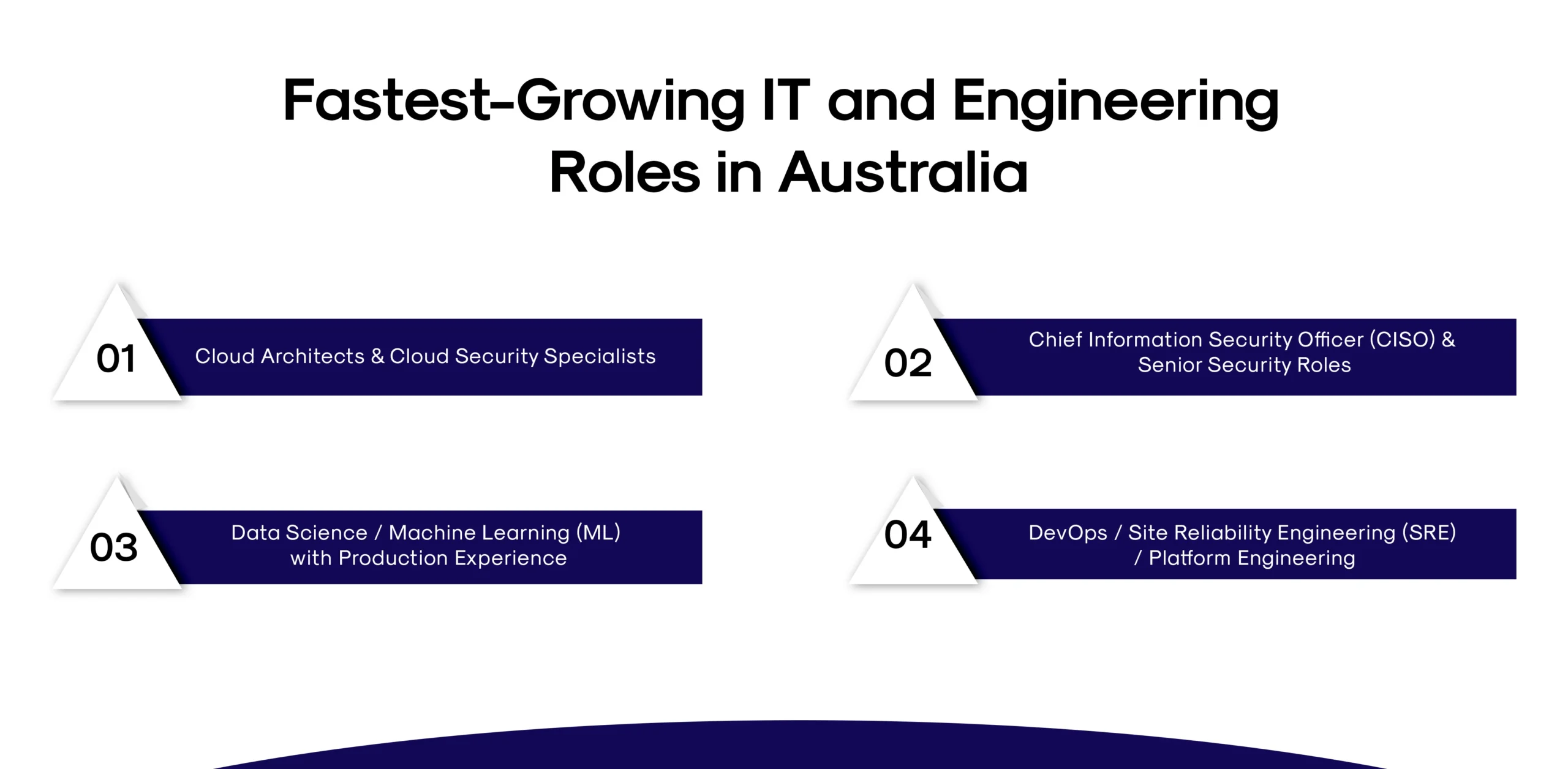
1. Cloud Architects & Cloud Security Specialists
Cloud use is expanding rapidly in all areas, such as finance and healthcare, government, and retail. Australian businesses are not merely offloading loads to the cloud but are modernising infrastructure, adopting hybrid cloud, and optimising cloud expenditure. This complexity generates a high demand for professionals able to design scalable cloud platforms and protect them against more and more advanced cyber threats.
Skills in demand: cloud architecture design, infrastructure as code (Terraform, ARM, CloudFormation), network security, DevSecOps, and cost optimisation.
2. Chief Information Security Officer (CISO) & Senior Security Roles
The cyber threats are on the increase and are becoming more sophisticated. In addition to that, Australia has improved regulatory clauses of data protection (e.g., APRA CPS 234 of financial services). Firms are compensating security executives because they can prevent breaches, impose compliance and protect confidential data.
Skills in demand: Security architecture, risk management, cloud security, threat intelligence, incident response, and compliance frameworks (ISO 27001, SOC2, NIST).
3. Data Science / Machine Learning (ML) with Production Experience
Data is no longer just an analytical tool; it drives revenue, operational efficiency, and product innovation. Organisations increasingly want operationalised ML models, meaning solutions that run reliably in production, rather than experiments in a lab. This shift has driven demand for data scientists and ML engineers with experience deploying scalable models.
Skills in demand: Python, R, TensorFlow, PyTorch, SQL, MLOps, data pipeline management, model deployment, and understanding of business KPIs.
4. DevOps / Site Reliability Engineering (SRE) / Platform Engineering
The firms are pressured to have software released quickly without jeopardising reliability. DevOps, SRE and platform engineering teams make infrastructure automated, scalable and resilient so that product development and deployment can be fast.
You would be required to have containerisation (Docker, Kubernetes) knowledge, cloud platforms (AWS, Azure, GCP) knowledge, CI/CD tools, automation scripts, monitoring and observability tools, and incident management.
Skills in demand: containerisation (Docker, Kubernetes), cloud platforms (AWS, Azure, GCP), CI/CD tools, automation scripts, monitoring and observability tools, and incident management.
Learn more: Contact us at cdraustraliahelp for more details. 👈 💯
Conclusion
The Australian IT and engineering industries are providing one of the most rewarding, dynamic international career opportunities. The demand for competent specialists is expanding in all industries, both at the highest levels of management, such as CIOs and CISOs, and at the most specific stages of cloud architecture, data science, and mining operations. The combination of technical skills, leadership, and knowledge in the area is extremely appreciated and translates to high salaries and high career advancement opportunities.
As a professional, it is important to know about the jobs that are the most in demand and those that have the most financial compensation to undertake in the future. With an ability to develop the skills that the market demands strategically, acquire the pertinent certifications, and prove the difference, one can prepare to obtain some of the most lucrative jobs in the Australian technology and engineering environment.
Whether your interest lies in digital innovation, data science, cloud technologies, or resource engineering, these top-paying roles highlight the opportunities available for those ready to invest in expertise, leadership, and continuous learning.
FAQs
1. What is the highest-paid IT job in Australia?
Chief Information Officer (CIO) is the best-paid IT position in Australia, attracting up to AUD 400,000 yearly.
2. What is the highest-paying engineering job in Australia?
The highest-paid engineering role in Australia is the role of the engineering director or the technical director, which is paid up to AUD 250,000 per annum.
3. Can international professionals apply for IT or engineering jobs in Australia?
Well, international professionals can migrate via skilled migration programmes or after being sponsored by employers to work in Australia.
4. Do I need a degree to work in IT or engineering in Australia?
Yes, most IT and engineering roles require a bachelor’s degree or equivalent qualifications, along with relevant certifications.
Recent Posts
-
 How to Migrate to Australia as a Software Engineer in 2026 – Complete CDR & Skills Assessment Guide
 -
 How Do You Become a Licensed Professional Engineer in Australia?
 -
 Best Online MBA Programs in Australia 2026: Top Rankings & Reviews
 -
 Documents Required for Skill Assessment for Engineers Australia
 -
 Mechanical Engineers (ANZSCO 233512): A Complete Guide to the Profession and Pathways in Australia