The idea of migrating to Australia as a professional is a dream for many. Migration Skills Assessment is an important process that ensures your skills, qualifications, and experience comply with the Australian standards of your nominated occupation. And although it may seem simple, there are numerous pitfalls that many applicants fall into, thereby taking their migration aspirations off course.
We have listed the most common errors that applicants commit during the skills assessment process in this comprehensive guide, along with how you can avoid these errors.
You can use this blog to ensure that your assessment is successful on the first attempt, regardless of the assessing authority you are using, VETASSESS, Engineers Australia, ACS or any other.
Table of Contents
What is a Migration Skills Assessment?
Migration Skills Assessment is a formal assessment by an Australian assessing authority to establish whether or not your foreign qualifications, work experience, and skills are appropriate in an Australian context in relation to the occupation you have nominated.
Most skilled visa programs, such as the Skilled Independent Visa (subclass 189), Skilled Nominated Visa (subclass 190), and the Skilled Work Regional (Provisional) Visa (subclass 491) have it as a compulsory requirement. All the occupations in the Skilled Occupation List are associated with a particular assessing authority that will evaluate your credentials.
An example is VETASSESS, which covers a broad spectrum of professional and general occupations; Engineers Australia, which covers engineering; the Australian Computer Society (ACS), which covers ICT and IT-related occupations; and Trades Recognition Australia (TRA), which covers occupations based on trade.
The right choice of occupation and measurement of authority is a key initial move in your migration procedure, since in case of discrepancy in your qualifications and work experience and the designated occupation, the assessment might end up not being positive, and this could lead to rejection of your whole visa application.
Why Mistakes in Your Skills Assessment Matter

Making mistakes in your Migration Skills Assessment can have serious and far-reaching consequences. A single error in the documentation, occupation choice or evidence you offer may lead to failures, delays and unnecessary costs. It’s important to understand how each of these issues can impact your Australian migration journey so you can plan carefully and avoid setbacks.
1. Application Delays
One of the most common consequences of mistakes is application delays. When your papers are lost, missing, or are not complete or clear, the evaluating office is likely to send a Notice of Further Information (RFI).
This process not only extends the assessment timeline by several weeks or even months but can also push back your overall visa application. These delays can be especially expensive to applicants who have limited time constraints to meet, such as expiring English test scores, Expression of Interest validity, or points requirements based on age.
2. Rejections or Negative Outcomes
Another major issue is rejection or negative outcomes. A single mismatch between your nominated occupation and actual job duties, a vague employment reference, or a poorly written Competency Demonstration Report (CDR) can lead to a “Not Suitable” result.
For engineers applying through Engineers Australia, plagiarism or lack of specific project-based evidence is one of the most common reasons for refusal. Similarly, applicants under VETASSESS or ACS who submit incomplete evidence of experience often find their applications rejected.
3. Lost Money and Time
The second notable effect of mistakes is the money and time wasted. Skills assessment is not only a tedious task but also a costly exercise. There are fees when applying, which differ depending on the authority and may be quite high, and are not refundable in the event of an unsuccessful assessment.
Considering that your first application was denied because of preventable errors, you will need to redo it, gathering new materials, rewriting reports, and repaying the fee. Such overlapping of efforts causes wastage of time and financial burden, particularly to the applicants who may be applying to several visa requirements at once.
4. Ineligibility for Points or Nomination
The other is the danger of ineligibility for points or nomination. The points-based migration system in Australia considers your age, work experience, qualifications and your English proficiency as all adding to your overall score. This can be directly affected by a poorly prepared skills assessment.
An example of this is when your assessing body fails to identify some of your work experience based on a lack of evidence, the years will not be included in your migration points. Likewise, by nominating an occupation incorrectly, you can become ineligible for certain state or territory nominations, narrowing your migration even more. Each single point counts, and even a slight variation can spell the difference between getting an invitation and not being picked in a competition draw.
Top Mistakes to Avoid in Your Australia Migration Skills Assessment
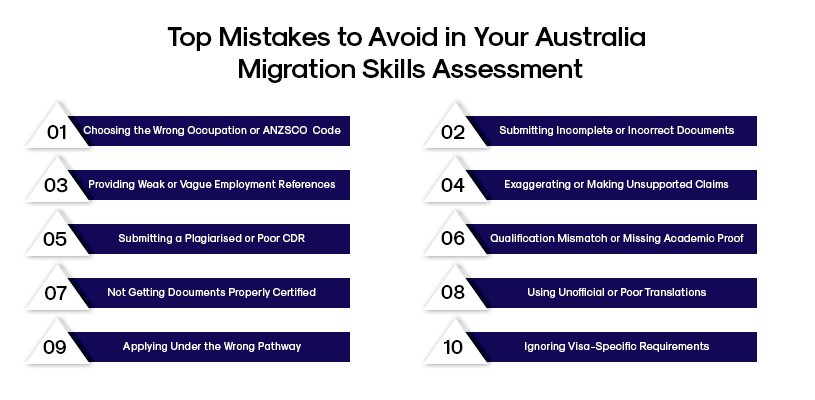
A positive Migration Skills Assessment (MSA) is one of the most important steps to undertake when applying for an Australian migration visa. Nevertheless, most applicants fail to realise that errors made could result in delays, denials, or even cause permanent ineligibility. A full list of the most frequent errors made by candidates, and how to eliminate them, is provided below in a clear, explanatory blog format.
1. Choosing the Wrong Occupation or ANZSCO Code
The most basic but most harmful error is the chosen ANZSCO occupation code. The Australian and New Zealand Standard Classification of Occupations (ANZSCO) presents definite occupation roles, necessary qualifications, and essential responsibilities.
In instances where what you actually do on a day-in, day-out basis does not fit with the occupation description, your application might be dismissed.
In order to prevent this, it is necessary that applicants understand ANZSCO occupation descriptions carefully, contrast them with their actual work experience, and not make the decision based only on job titles. In case of any doubts, you can save yourself a lot of money by hiring the services of a registered migration agent or requesting the corresponding authority to evaluate you first.
2. Submitting Incomplete or Incorrect Documents
One of the most common causes of delayed/refused assessment is incomplete documentation. Evaluating authorities will not conjecture or conclude the absence of information. Some of the typical pitfalls are a lack of signatures, ambiguous scans, and omission of certified copies or official translations.
Each assessing organisation has a given checklist, and utilising an outmoded or inappropriate version can be lethal to your application. To prevent this trap, it is important to have the very latest checklist, ensure that all of the documents are clear, full page, and certified, and to make sure that any translation is of official quality.
3. Providing Weak or Vague Employment References
Your skills and experience are cemented in your employment references. Regrettably, some applicants only present general reference letters that are not detailed or confirm some important details of employment. An example is a statement that merely reports that John was a Civil Engineer with us between 2018 and 2022.
These should instead be provided with the exact date of employment, full-time or part-time employment, salary, description of the job, and printed on the company letterhead with contact information of the person who is signing. The more accurate and verifiable the reference, the better your case. The weak references are usually followed by requests for additional information (RFI) or a refusal as such.
4. Exaggerating or Making Unsupported Claims
Other pitfalls include exaggerating your job or responsibilities and trying to match the job requirements. Attractive as it might be to say that you managed or did technical work that you did not actually do, this will backfire many times. You can evaluate authorities by comparing your assertions to evidence, including payslips, tax records or contracts.
Any discrepancy can be a cause of suspicion, which results in refusals and even fraud. The wisest and most prudent way is to be honest and factual. Give tangible evidence of all claims, and don’t be an exaggerator.
5. Submitting a Plagiarised or Poor CDR
The Competency Demonstration Report (CDR) is an essential document for engineers who submit their applications via Engineers Australia. The problem is that most of these applications are copied or rewritten from text or images on the Internet, so they are considered plagiarism.
Engineers Australia have sophisticated software to detect plagiarism, and slight similarity can lead to rejection. Winning requires writing original career episodes, outstanding presentation of your engineering competencies and problem-solving skills and strict adherence to the official CDR guidelines. Third-party writing services should be avoided; authenticity is a prerequisite.
6. Qualification Mismatch or Missing Academic Proof
The qualifications that you hold should correspond to the Australian Qualification Framework (AQF). Attaching degrees or diplomas that fall below these criteria or the absence of a full academic transcript can fail the assessment.
You should always carry official transcripts, degree certificates, and, where applicable, course outlines or syllabi to help explain what you have studied. When your qualification is obtained in a lesser-known institution or a different system, approach the assessing authority to ensure that it can be considered comparable.
7. Not Getting Documents Properly Certified
Most skills assessments require certification. Any application that is not certified or certified improperly will not hold any water. Signing: Each page should be signed, dated and stamped by an approved certifying body (Justice of the Peace or Notary Public). Various organisations can also have certain certification guidelines, so keep to the regulations of the assessing organisation that you have decided upon.
8. Using Unofficial or Poor Translations
In case any of your documents are not written in English, you can just provide unofficial translations and get dismissed right away. The translation should be done by an NAATI certified translator (in Australia) or by a qualified translator in your native country. In any case, the original document and its translation should always be there with seals and signatures that are easy to see and read.
9. Applying Under the Wrong Pathway
Most of the assessing bodies provide a variety of assessment routes, including a qualification-only route or a qualification and experience route. It is a common mistake to apply it in the wrong direction.
An example is the situation where an applicant can still be qualified by a Recognition of Prior Learning (RPL) route or an experience-based route, even without formal tertiary qualifications. To make sure you fit the criteria, take time to review the eligibility criteria of each pathway and apply only when qualified.
10. Ignoring Visa-Specific Requirements
What you are assessed to do should be in line with your desired visa subclass. Certain visas can also demand a recent assessment or other requirements, including the Skilled Independent (189) or Skilled Nominated (190) visas.
By not taking into consideration these specifics, your assessment may be declared invalid at the moment of visa application. Check the subclass requirements and validity period before going.
What are the Tips for a Smooth Assessment?
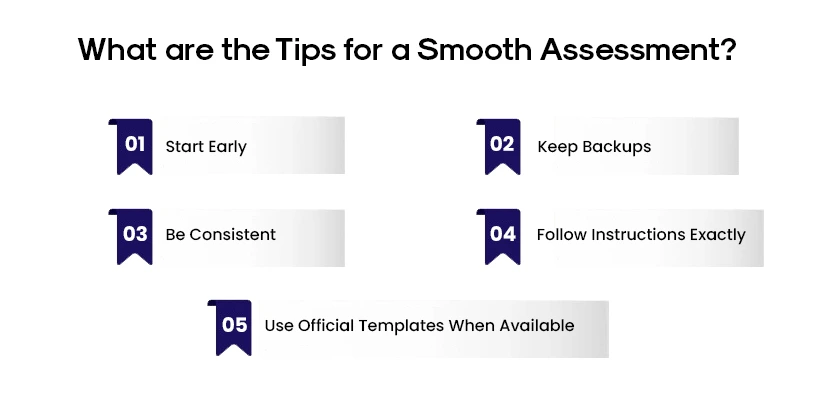
1. Start Early
The very first suggestion for using skills assessment as a successful tool is to begin preparing as far ahead as you can. Gathering employer reference letters, academic transcripts, and certified translations may take weeks to months in some cases – unless your former employers are prompt with their replies or the papers must be officially notarised.
Early starts allow you the time to find missing information, get corrections made, or seek clarification of any discrepancies before it is too late. Early planning is also less stressful, and it gives you time to organise around visa dates, Expression of Interest (EDI) dates, or English test dates. Self-buffering really guarantees that things do not come up at the nick of time and ruin your application.
2. Keep Backups
You should have more than one copy of every document, such as original certificates, reference letters, and translated copies. Although digital copies are convenient, sometimes the authorities might demand original copies or certified copies to verify the same.
The last-minute loss of an important document will either slow down your application or require reissuing it at a high cost. The purpose of backups is also to ensure that there are no errors in the system when submitting the requirements. Arrange them into a safe, orderly fashion-such as by category (academic, employment, identification) and by date-to allow easy and efficient access to a particular document.
3. Be Consistent
Coherence in all the documents presented is essential. These contain names, dates, job titles, terms of employment and other essential information. The differences that might be considered, even something like the use of a nickname in one document and a full name in another or the fact that the assessor notes the employment date is slightly different, could be a red flag and lead to either clarification or refusal.
Check each document with your CV, reference letters, and academic records before turning them in. Even one wrong word will look like you are trying to pump up or lie about your experience, thus you should be very careful about details.
4. Follow Instructions Exactly
Each evaluating body has its own peculiarities and submission rules. Individually, the templates, document formats, and evidence requirements are different in Engineers Australia, VETASSESS and ACS. Quickness to break rules, even in small details, like not using the right template or forgetting to add a signature, can cause your application to be withdrawn or discarded.
Instruct the instructions properly, verify them against the official checklist, and make sure that all the documents are written in the corresponding format, certified, and translated. Doing things as per the instructions is the best way to show professionalism and eliminate the possibility of unwarranted delays.
5. Use Official Templates When Available
Most evaluating bodies offer official templates of important documents like a statement of service, a competency demonstration report or a letter of employment verification. With these templates, you will not forget to add any of the information necessary, and it will be in the right format to avoid any chances of leaving out important information.
Templates also contribute to consistency and clear readability, which is valued by the assessors. Any deviation can be confusing or may cause further questions, and it is always better to follow the templates given by the assessing body when you can.
Conclusion
Migration Skills Assessment is the key to your successful migration to an Australian skilled visa and one of the most decisive factors in whether your migration route will be pleasant or full of setbacks and troubles.
It takes detailed planning, attention to detail and a systematic approach to get a positive result; even minor details will cost you months or even years of work were they lead to delays, demand more information or even an absolute refusal. Honesty, thoroughness and thorough compliance with the instructions given by your assessing authority are the most important principles to remember during the process.
FAQs
1. What is a migration skill assessment?
Migration skill assessment is a process to evaluate your qualifications and work experience against the requirements of your nominated occupation for migration purposes.
2. How long is a positive skills assessment outcome valid?
A positive skills assessment outcome is typically valid for 3 years from the date of issue.
3. What happens in skill assessment in Australia?
In Australia, a skills assessment involves evaluating your education, qualifications, and work experience to ensure they meet the standards for your nominated occupation, which is required for migration or skilled visa applications.
4. How can I prepare for a skill assessment?
To prepare for a skills assessment, you should gather your qualifications, work experience, and supporting documents and ensure they meet the assessing authority’s requirements.
Recent Posts
-
 How to Migrate to Australia as a Software Engineer in 2026 – Complete CDR & Skills Assessment Guide
 -
 How Do You Become a Licensed Professional Engineer in Australia?
 -
 Best Online MBA Programs in Australia 2026: Top Rankings & Reviews
 -
 Documents Required for Skill Assessment for Engineers Australia
 -
 Mechanical Engineers (ANZSCO 233512): A Complete Guide to the Profession and Pathways in Australia