
The Australian Computer Society (ACS) requires IT professionals who want to migrate to Australia to complete their ACS Skill Assessment. The ACS determines if your skills match the Australian standards for IT-related professions.
A well-designed ACS skill assessment checklist helps you present all required documents correctly, which prevents both delays and application rejections. This guide provides a comprehensive list of documents needed for the ACS Skill Assessment, enabling you to submit your application without complications.
Table of Contents
What is ACS Skill Assessment
The Australian Computer Society (ACS) performs formal skill evaluations through its ACS Skill Assessment process, which serves as the professional body for Information and Communications Technology (ICT) in Australia.
The ACS assessment evaluates IT professionals seeking migration to Australia through skilled migration visas, including Subclass 189 (Skilled Independent), Subclass 190 (Skilled Nominated), and Subclass 491 (Skilled Work Regional).
What Are the Documents Required for ACS Skill Assessment?
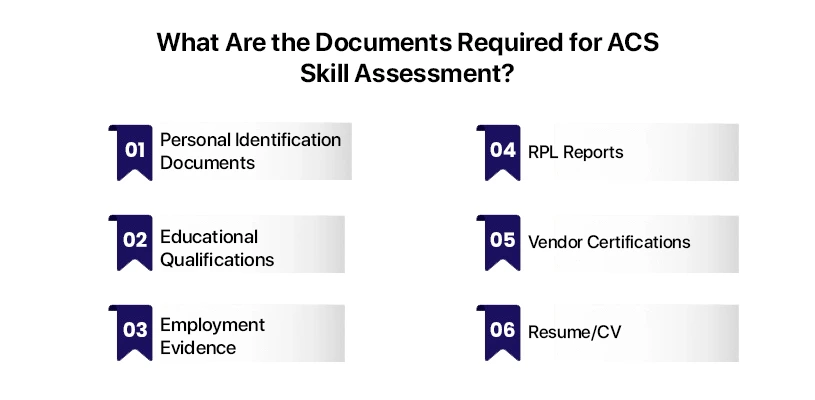
The ACS document checklist functions as your guide for preparing a successful application. Any mistake in your document submission or missing documents can lead to processing delays or outright rejection. The following section presents the essential document categories that align with ACS skill assessment requirements.
1. Personal Identification Documents
The ACS requires you to establish your identity as their priority. These documents confirm your identity and verify that all information matches correctly.
Passport
The identification page of your passport requires a colour scan showing your photo, together with your name and date of birth.
Secondary Photo ID
The secondary identification document should be either your driver’s licence or your national ID card from your home country. Your identification document requires both your photo and name.
Proof of Name Change (if applicable)
Show your marriage certificate or legal document that demonstrates the name change.
Ensure that your passport name matches exactly with your application name. A single discrepancy between application information and passport details will result in future complications.
2. Educational Qualifications
Your academic qualifications need to be demonstrated as the next step. The ACS needs to see your academic records along with their connection to your selected ICT occupation.
Degree or Award Certificate
A colour scan of your diploma or degree certificate. The document must display the educational programme title (Bachelor of Computer Science) and the university name, together with the completion date.
Academic Transcripts
Academic transcripts present a detailed overview of your enrolled courses, together with your academic performance. You must provide academic documentation from your entire period of enrolment instead of only your graduation year.
Master’s or Additional Qualifications
Submit your postgraduate degrees along with your undergraduate documents when you have additional qualifications.
Documents written in languages other than English require certified translations from translators who hold accreditation, according to later discussion.
3. Employment Evidence
The assessment process heavily relies on your work experience when you apply through the General Skills or RPL pathways. The ACS requires evidence demonstrating your professional-level ICT work activities.
Employment Reference Letters
Employment reference letters require official company stationery with signatures from your employer or authorised personnel, who should provide the following information:
- The document should authorise personnel unless you continue working at your current position.
- Your job title, together with detailed duties, must match the ANZSCO code you have selected.
- A full-time workweek consists of 20 or more hours per week.
- The country served as the workplace for this work.
Payment Evidence
Payment evidence should include payslips together with tax records and bank statements showing salary deposits and superannuation/insurance documents. The documents demonstrate that you received payment for your work.
Statutory Declarations (if needed)
A notarized statutory declaration from a colleague or supervisor can substitute reference letters when companies close down, but only when direct reference letters are unavailable.
The Australian Computer Society does not recognise work experience from part-time jobs that exceed 20 hours per week or unpaid internships.
4. RPL Reports
To proceed without an ICT degree or sufficient qualifications, you must submit a Recognition of Prior Learning (RPL) report. Through experience, you can demonstrate your abilities in this opportunity.
RPL Application Form
The RPL Application Form can be obtained from the ACS website and needs to be completed.
Two Project Reports
The assessment requires two reports describing professional projects you completed during the past three to five years. The reports should contain 1,000-1,500 words that describe your responsibilities, technical abilities, and project achievements. Reports should directly connect to the ANZSCO code you selected because general reports will not satisfy the assessors. Showcase your problem-solving abilities together with your technical expertise
5. Vendor Certifications
The application process for DevOps or cybersecurity positions becomes stronger through having specific vendor certifications that include Cisco and Microsoft.
Certificates
Submit colour scans of your certificates.
Login Credentials
The verification process requires vendor account login credentials, such as Microsoft or Cisco credentials.
6. Resume/CV
The submission of a resume is advisable, though it remains optional. The ACS benefits from an immediate summary of your professional background through this document.
What to Include: Education, work history, skills, and certifications. Keep it concise but detailed.
How Do I Upload Documents to ACS?
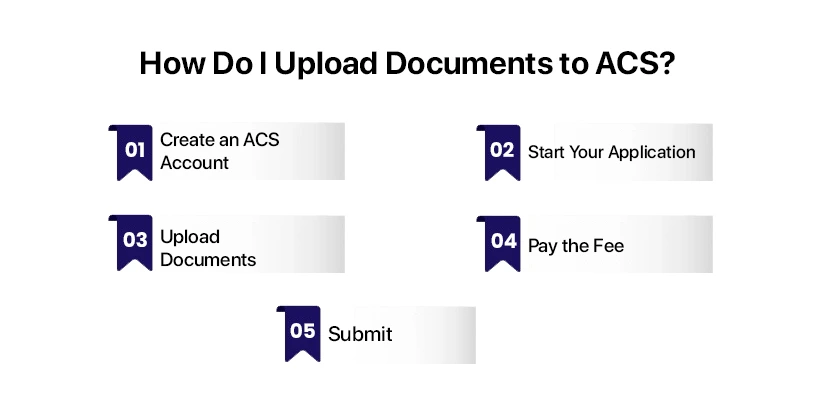
The document submission process is simple through the online platform, according to these steps:
1. Create an ACS Account
You need to visit the ACS website at acs.org.au to create an account and then access the applicant portal through your login.
2. Start Your Application
The first step involves choosing your assessment type (general skills or RPL), followed by completing the online registration form with your information and work history details.
3. Upload Documents
The portal contains separate sections for each document type that you need to upload. Upload your PDFs here. Phone users can benefit from using the QR code feature.
4. Pay the Fee
The ACS skill assessment fee depends on your pathway selection and costs between AUD 500 and AUD 1,450 (we will discuss this fee structure in detail later). The application fee can be paid through Visa, Mastercard, PayPal, or American Express payment methods.
5. Submit
After verifying all inputs, you should click submit. The confirmation email will contain a reference number after your submission.
A screenshot of your application summary page should be taken before you submit it. The reference number serves as a lifesaving tool for future needs.
ACS Skill Assessment Requirement
Your qualifications and experience determine the requirements for ACS skill assessment.
The skill assessment requires ICT-qualified candidates to demonstrate 2-8 years of relevant work experience after completing a degree with an ICT major that matches their nominated occupation.
To obtain the skill assessment through RPL, you must demonstrate at least 6 years of ICT work experience while submitting an RPL report.
Students who completed their studies in Australia may qualify for either one year of local work experience or completion of an ACS Professional Year Programme.
The ANZSCO code system helps the ACS identify your occupations through skill matching (Software Engineer – 261313). Select an appropriate code from ANZSCO and verify that your supporting documentation matches it.
ACS Skill Assessment Guidelines
ACS skill assessment guidelines function as the official document that directs your application process. The complete guidelines exist on the ACS website under the Skills Assessment Guidelines for Applicants PDF document, although the main points are as follows:
Your ANZSCO code selection requires qualifications and experience that match its requirements.
The work requirements at this level must demonstrate proficiency at the skilled level beyond entry-level or volunteer standards.
The full-time work is only 20+ hours/week.
The ACS maintains the ability to check with employers when they have any suspicions.
Real Talk: Read the guidelines. The guidelines are dry, but following them correctly leads to either a successful application or an unsuccessful rejection.
How Does the Australian Embassy Verify Documents?
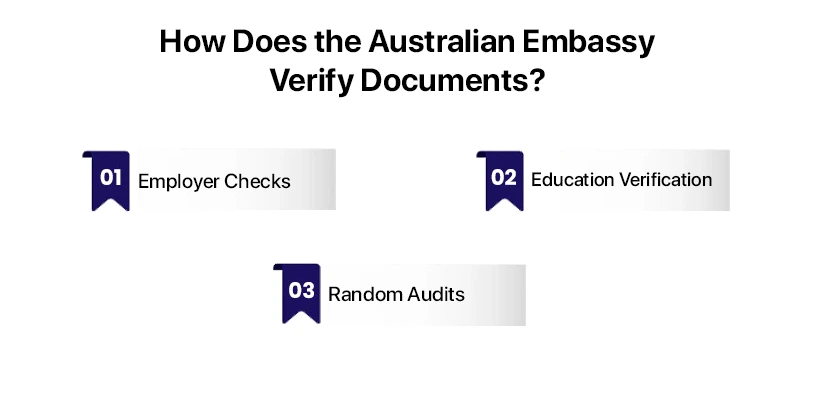
ACS evaluates your documents, and the Department of Home Affairs will confirm them if your visa application proceeds to their department. Here’s how it could happen:
1. Employer Checks
Your previous employers might receive enquiries from the employer checks to validate reference letters.
2. Education Verification
Universities would receive requests to verify academic degrees during the assessment process.
3. Random Audits
The department conducts random integrity checks through workplace visits, which are uncommon but possible.
The ACS part of verification relies on internal checks, where they examine documents to ensure their information matches. They will request additional information when they identify any inconsistencies, such as unclear scans or inconsistent dates.
ACS Skill Assessment Fee
The fee for ACS skill assessment depends on the pathway you choose between General Skills and RPL, and Temporary Graduate (485) and Post-Australian Study.
General Skills: AUD 1,450
RPL: AUD 1,550
Temporary Graduate (485): AUD 500
Post-Australian Study: AUD 1,350
The service for urgent visa deadlines under 12 weeks comes with additional fees, while appeals that challenge the decision outcome result in increased costs. Payment through the online system is required at the time of submission, and we do not accept cash or checks.
Consider translation expenses when your documents are not in the English language. The translation of documents for the visa application process may cost between AUD 100 and AUD 300, based on the amount of material that needs translation.
How Does the Australian Embassy Verify Documents?
ACS completes document assessment before the Australian Embassy conducts extra verification steps when someone applies for a visa. Here’s how they verify:
The Australian Embassy verifies information by comparing your submitted documents against Australian government databases
ACS will reach out to your employer to verify your employment background.
ASC verifies your educational documents by checking them against the records of your university.
The review process for the RPL report includes a thorough evaluation of both your skills and projects.
The submission of authentic documentation along with precise information will help you prevent issues
ACS Skill Assessment Checklist

To verify their accuracy, you should review your documents against the ACS skill assessment checklist. The assessment process resembles email proofreading, which serves as a vital step to prevent errors from occurring.
1. Colour Scans Only
Colour scans must be used instead of black-and-white copies. The image resolution needs to be set at 300 dpi or higher to achieve clear results.
2. Documentation Format
PDF Organisation requires you to merge documents that belong together (such as degrees and transcripts) into one PDF file, yet maintain distinct sections (education documents in separate files from employment information).
3. File Size
The maximum PDF file size should not exceed 3MB with both encryption and read-only features disabled.
4. Translations
Documents that are not in English must be translated by a certified professional translator who is either NAATI accredited in Australia or approved by the embassy of your country. Provide the original version and its translation to the authorities.
5. Completeness
The absence of either a transcript or a reference letter indicates incompleteness in your application. The ACS will require this information, which leads to a delay in the application process.
Conclusion
The ACS Skill Assessment application requires thorough preparation from applicants. By submitting proper documentation, you will experience an efficient application process, which boosts your opportunity for success. Verify your ACS checklist while uploading clear, valid documents and paying your ACS skill assessment fee before deadlines.
Migrating to Australia as an IT professional requires this step to be completed properly. Follow every guideline in the ACS skill assessment process to prevent delays or rejection of your application.
FAQs
1. How long does an ACS assessment take?
The ACS assessment duration extends from 8 to 10 weeks based on your case complexity and the total number of applications received.
2. Can I submit additional documents after my application?
Yes, the application process allows additional document submission following your initial submission.
ACS enables document resubmission upon request, yet this action might extend the processing time.
3. What happens if my ACS Skill Assessment is unsuccessful?
ACS gives feedback to applicants whose applications are denied. You have two options for continuing your application process: submit a new application with the needed improvements or ask for a review.
4. How much is the ACS Skill Assessment fee?
The assessment fee amounts to different costs based on the assessment type. The current ACS fee structure is available on the official ACS website.
Recent Posts
-
 How to Migrate to Australia as a Software Engineer in 2026 – Complete CDR & Skills Assessment Guide
 -
 How Do You Become a Licensed Professional Engineer in Australia?
 -
 Best Online MBA Programs in Australia 2026: Top Rankings & Reviews
 -
 Documents Required for Skill Assessment for Engineers Australia
 -
 Mechanical Engineers (ANZSCO 233512): A Complete Guide to the Profession and Pathways in Australia