

Online MBA programmes are becoming more popular in a world that is becoming more receptive to flexibility, remote work, and online credentials. For working professionals who balance career and family matters and other engagements, an online MBA can be a way to enhance skills and credentials without changing or interrupting employment.
The higher education sector in Australia is highly regarded in the world, and various institutions in Australia have currently introduced high-quality online MBAs that are equal to their on-campus counterparts in terms of rigour, accreditation and outcomes. Nevertheless, ‘best’ is a relative word: it is dependent on its cost, accreditation and the return on investment (ROI) or the design of the programme, specialisation, networking possibilities and so on.
This guide aims to help you navigate the landscape in 2026.
Table of Contents
QUICK COMPARISON TABLE: Top 10 Online MBA Programs
Below is a comparative snapshot of what some of the top online MBA programmes in Australia look like in 2026. Use this to get a high-level view before we go deeper:
| Rank | Institution / Program | Duration (part-time/full) | Approx Tuition (AUD) | Accreditations |
| 1 | AGSM @ UNSW — MBAX | ~2 years (part-time) | ~ AUD 68,000 (12 courses × ~5,670) | AACSB, EQUIS etc |
| 2 | Melbourne Business School — Online MBA | Flexible (modular) | (subject to per-subject costing) | Accredited |
| 3 | Adelaide Business School — Online MBA | ~2 years | ~ AUD 4,986 per subject | AACSB |
| 4 | RMIT Online — MBA | Flexible | – | – |
| 5 | SCU Online — MBA | Flexible/low cost | – | – |
| 6 | Australian Institute of Business (AIB) — Fast-track MBA | 12 months (full) / part-time | – | – |
| 7 | Deakin University — Online MBA | Flexible / part-time | – | AACSB |
| 8 | University of South Australia — MBA Online | – | – | – |
| 9 | Torrens University / Torrens MBA (online mode) | – | – | – |
| 10 | Central Queensland University / La Trobe / others | – | – | – |
METHODOLOGY: How We Ranked These Programs
To produce a credible and balanced ranking, we used a combination of quantitative and qualitative criteria. Here’s a breakdown of the methodology:
Criteria & Weightings
Accreditation & Quality Assurance (15%)
- Presence of AACSB, EQUIS, AMBA or equivalent
- National accreditation and regulatory compliance in Australia
Global / Regional Rankings & Recognition (15%)
- Inclusion in rankings like FT Online MBA, CEO Magazine, etc.
- Reputation internationally and within the Asia-Pacific
Return on Investment/Outcomes (15%)
- Graduate salary uplift
- Employment outcomes/job placements
- Alumni networks, career services
Cost & Affordability (10%)
- Total tuition (or cost per subject)
- Hidden fees, resource costs, support services
Flexibility / Delivery & Format (10%)
- Modular scheduling, asynchronous vs synchronous
- Ability to pause and exit with an interim credential
- Blended residencies, optional intensives
Specialisation & Curriculum Options (10%)
- Variety of elective tracks, minors
- Business analytics, digital, leadership, sustainability, etc.
Student Support, Technology & Engagement (10%)
- Online learning platforms, peer groups, mentoring, and virtual networking
- Technical infrastructure and support
Student Reviews / Experience & Alumni Feedback (5%)
- Testimonials, forums, and alumni satisfaction
Global/Domestic Diversity & Reach (5%)
- International student mix, cross-border reach
Institutional Brand / Prestige / Legacy (5%)
- Business school legacy in Australia and overseas.
The sources of the data that we gathered were institutional websites, international ranking magazines (e.g., Financial Times, CEO Magazine), third-party directories (e.g., FindMBAOnline, EducationS.com), and existing student/alumni feedback.
In case of missing or unclear data, we marked that. Due to the high rate of evolution of online MBA programmes, in 2025-2026, we give more emphasis to the most recent data. 2025-2026.
TOP 10 BEST ONLINE MBA PROGRAMS IN AUSTRALIA 2026
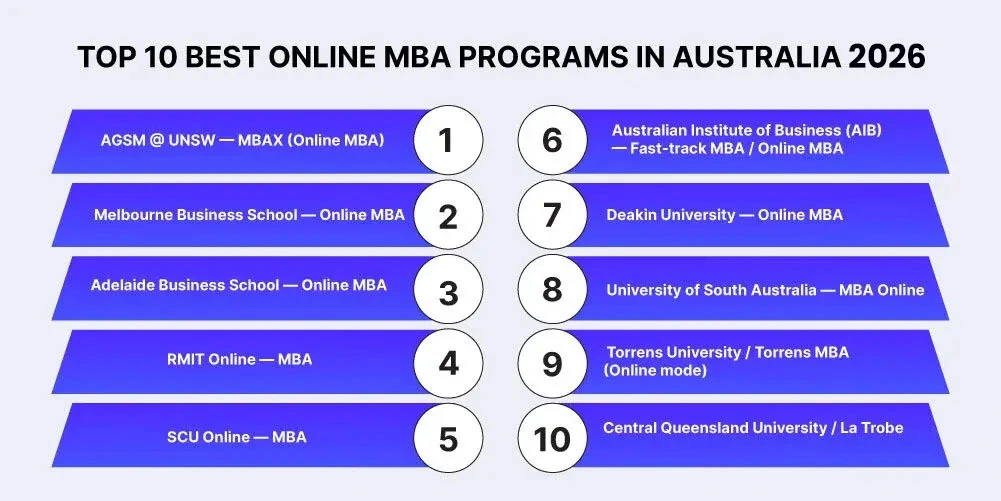
The following are more detailed profiles (strengths, trade-offs, highlights) of our top 10 picks.
1. AGSM @ UNSW — MBAX (Online MBA)
Why it ranks #1:
AGSM’s MBAX programme is the only Asia-Pacific MBA to make the top 10 of the Financial Times Online MBA 2026 list.
-
- Structure & Duration: Part-time over ~2 years, 12 courses.
- Cost: Approximately AUD 5,670 per course, total ~AUD 68,040
- Strengths:
-
- Strong brand and global reputation
- Robust alumni network and corporate ties
- Flexible structure and specialisation in Change, Technology, and Finance
- High post-MBA salary outcomes and prestige
- Trade-offs:
- Cost is significant
- Competition for admission is stiff
- May require good time management to balance work and coursework
2. Melbourne Business School — Online MBA
-
- Why it’s in the top tier: Melbourne Business School enjoys top standing in Australian MBA rankings and is among the most reputable business schools in Oceania.
- Structure: Modular, flexible, offering six intakes per year.
- Strengths:
-
- Prestigious brand and high recognition
- Strong networking opportunities and industry linkages
- Flexibility in scheduling and continuous start dates
- Trade-offs:
- Precise tuition per subject is less transparent
- Some intensives/residencies may require travel
3. Adelaide Business School — Online MBA
-
- Why it ranks well: Offers a well-balanced online MBA with a strong track record and accreditation.
- Structure & Duration: ~2 years part-time
- Cost: ~AUD 4,986 per subject (2026)
- Strengths:
-
- More cost-effective among top names
- Strong support infrastructure
- Good balance of quality and affordability
- Trade-offs:
- Fewer specialisation tracks than some peers
- Less prestige globally compared to AGSM/Melbourne
4. RMIT Online — MBA
-
- Why it ranks: RMIT is known for its innovation and industry orientation; its online MBA is designed for current trends.
- Structure: Flexible; students can choose minors/specialisations.
- Strengths:
- Agile curriculum focused on future skills
- Good for those seeking specialisation flexibility
- Trade-offs: Less global prestige than some
- Tuition / exact structure details need direct confirmation
5. SCU Online — MBA
-
- Why it ranks: SCU has built a reputation for affordability and accessibility in online MBA delivery.
- Strengths:
-
- Lower-cost alternative
- Good learner support and flexible scheduling
- Trade-offs:
- Fewer brand advantages
- Smaller alumni and networking reach
6. Australian Institute of Business (AIB) — Fast-track MBA / Online MBA
- Why it ranks: AIB is the largest online MBA provider in Australia in terms of student enrolment.
In 2026, AIB’s online MBA achieved Tier One status in CEO Magazine’s rankings and was ranked #25 globally in the online MBA segment.
-
- Structure: Flexible online with fast-track options
- Strengths:
-
- Very experienced in online education
- Broad reach and student base
- Strong support systems for online learners
- Trade-offs:
- Brand recognition can lag behind traditional universities
- Fewer specialisation options
7. Deakin University — Online MBA
-
- Why it ranks: Deakin’s business school is long respected; its MBA programmes have often achieved top GMAA star ratings.
- Strengths:
-
- Solid reputation and regional recognition
- Good infrastructure and support for online learners
- Trade-offs:
- Tuition and specialisation details are less visible
- Less international prestige compared to AGSM / Melbourne
8. University of South Australia — MBA Online
-
- Why it ranks: Frequently featured in the CEO Magazine’s global online MBA rankings.
- Strengths:
-
- Good balance of value and recognition
- Strong domestic reputation
- Trade-offs:
- Limited specialisation compared to top peers
- International brand impact is moderate
9. Torrens University / Torrens MBA (Online mode)
-
- Why it ranks: Among recognised online MBA providers in Australia, it appears in guides like Education Services and MBA directories.
- Strengths:
-
- Flexible structure
- Recognised among online MBA provider lists
- Trade-offs:
- Less robust brand globally
- Enrollment scale smaller
10. Central Queensland University / La Trobe
-
- Why they appear: These schools often appear in CEO Magazine’s global online MBA rankings (e.g., Central Queensland University is among those listed in CEO’s 2026 list)
- Strengths:
-
- More accessible entry criteria
- Lower tuition in some cases
- Trade-offs:
- Limited specialisation options
- Lower prestige and alumni network reach
BEST ONLINE MBA BY CATEGORY
Different students have different priorities. Here are some recommended picks by your priority:
| Priority / Need | Best Pick(s) & Why |
| Top prestige & brand / global recognition | AGSM MBAX, Melbourne Business School |
| Best value / cost-conscious | Adelaide Business School, SCU Online, CQU / La Trobe |
| Fastest / accelerated completion | AIB (Fast-track), some modular intakes at Melbourne / AGSM |
| Best specialisation options (e.g. tech, analytics, change) | AGSM MBAX, RMIT (minors), Melbourne |
| Strongest online learner support & experience | AIB, AGSM, Adelaide |
| Best for international/remote students | AIB, Adelaide, SCU, Torrens |
| Easiest admission / more flexible entry | CQU, La Trobe, SCU, Torrens |
These picks reflect trade-offs: for example, the most prestigious programme may also be the most expensive; the lowest cost may come with trade-offs in network and branding. Always align choices with your career goals.
COST COMPARISON: Online MBA Fees in Australia
Understanding the cost landscape is crucial. Here’s what we know in 2026:
Typical MBA Fee Ranges (Australia, all formats)
- MBA News Australia states that in 2026, the fees of a full MBA will be between approximately AUD 16,000 (some lower-ranking programmes) and AUD 153,000 (Senior Executive MBA in the best business schools).
- The average cost of most full-time MBA programmes is between AUD 50,000 and AUD 80,000.
- The average MBA in Australia is AUD 64,211.
- The average price across all formats (including online) is approximately AUD 60,000.
Online MBA Specifics & Examples
- AGSM MBAX: Approx. AUD 5,670 per course x 12 courses = Approx. AUD 68,040.
- Adelaide Business School: AUD 4,986 per subject
- There are also some low-cost or more affordable programmes, e.g., the Victorian Institute of Technology online MBA, which is listed as low as AUD 16,000 in some listings.
- Hidden/additional costs: books, software, residencies or intensives, travel for in-person weekends (if required), and technology/platform fees.
Comparison & What to Watch Out For
- Cost per subject: There are those programmes that divide the cost of tuition unit by unit; this assists in cash flow management.
- Part-time vs full-time rate: Online, most are part-time, so the cost is distributed.
- Additional fees: technical support, proctored exam fees, overseas study tours (for blended programmes).
- Scholarships/bursaries/payment plans: A lot of institutions are providing partial scholarships, internal awards, deferred payment or employer sponsorship.
When two programmes are compared, you should always be able to calculate the total cost (inclusive of tuition fees and additional fees) and the anticipated ROI (salary increment, career development).
ACCREDITATION GUIDE: What You Need to Know
An accredited MBA is not a choice but a quality, recognition and ROI. Here’s what to check:
Major Accreditations
- AACSB (Association to Advance Collegiate Schools of Business): a worldwide standard, intensive faculty and curriculum examination.
- EQUIS (European Quality Improvement System): focuses more on connections with international business and corporate relevance.
- AMBA (Association of MBAs): commonly used in reference to the MBA degree.
- Local Australian Accreditation / Higher Education Regulation: compliance with the Tertiary Education Quality and Standards Agency (TEQSA) in Australia
Triple crown accreditation indicates that the school has the three (AACSB, EQUIS, AMBA). QUT Business School is among the few Australian institutions that are triple-accredited.
Accreditation ensures:
- International recognition (employers worldwide trust your degree)
- Assurance of academic rigour, quality faculty, and up-to-date curriculum
- Likelihood of stronger career services and alumni connections
- Easier credit/recognition for further education (e.g., doctoral, executive programs)
- When assessing programmes, always check institution websites for their accreditation status.
ONLINE MBA ROI: Salary Increases & Career Outcomes
One of the most critical questions: Will you recoup your investment? Here’s what data and industry trends suggest:
Salary Uplift & Career Outcomes
- AGSM’s MBAX has historically delivered strong salary outcomes. Its global ranking in FT implies robust alumni performance and salary growth.
- In Australian full-time MBAs, top programmes report post-MBA average salaries in the range of AUD 90,000–150,000. (While not specific to online, it gives context.)
- In general, MBA graduates in Australia command higher managerial roles, which often come with significant salary increments.
- Your salary prior to MBA, industry and location are of great importance in ROI. When you are in middle management, the percentage boost may not be much, but still, the absolute increase may be significant.
Other ROI Measures/Benefits
- Promotion & Leadership Roles: MBAs are taken into account by many organisations in terms of leadership pipelines.
- Network & Access: The network you acquire (classmate, alumni, corporate tie-ups) does not necessarily open the door to salary.
- Skill Refresh / Career Pivot: For those shifting industries (e.g., moving into consulting or digital transformation), the skills and brand matter.
- Intangible Returns: Soft skills, credibility, confidence, and opportunities for international placements.
Caveats and Realities
- There is no guarantee of ROI – bad time management or poor-performing programmes will reduce returns.
- Overpaying for a less reputable programme with a weak network may result in negative ROI.
- Consider opportunity cost: the salary you forego (if reducing hours) while studying.
A strong heuristic: aim for a programme where the ratio of expected salary uplift to net cost (after factoring in likely time to recoup) is favourable.
ADMISSION REQUIREMENTS FOR TOP PROGRAMS
While each university has its own specific requirements, common themes and criteria apply. Here’s a summary:
| Requirement | Typical Minimum / Expectation | Notes & Tips |
| Undergraduate degree (bachelor’s) | Recognised bachelor’s degree (often 2nd class/equivalent) | Some programs may accept equivalent experience in lieu |
| Work experience | 2–5 years (sometimes minimum 3) | Leadership, managerial or professional work is preferred |
| GMAT / GRE | Some programs require or accept (e.g. ~500+), but many waive it depending on experience | AGSM MBAX may be more flexible with work experience |
| English proficiency | IELTS / TOEFL / PTE (e.g. IELTS 6.5+ or higher) | Especially for international students |
| Resume / CV | Detailing work history, achievements, and leadership | Make it relevant and highlight growth |
| Letters of recommendation | Often 2 (academic or professional referees) | Choose recommenders who can speak to leadership, analytical ability |
| Personal statement / Statement of Purpose | Articulate your goals, fit, and plans | Very important to distinguish your application |
| Interview / Assessment | Some schools conduct an interview (virtual) | Be prepared to discuss your career, leadership, and motivations |
For top-rated programmes like AGSM, competition is fierce, so excellence across all these dimensions is essential.
How to choose the right online MBA program
Selecting a programme is a deeply personal decision, but here’s a decision framework to guide you:
1. Define your goals & timeline
- Are you looking for promotion, an industry switch, a return on salary, or entrepreneurship?
- How long do you want to study?
2. Evaluate cost vs ROI
- Compare “all-in” cost vs expected uplift
- Look at alumni outcomes
3. Check accreditation & reputation
- The standard must include at least AACSB, EQUIS, or AMBA
- Global recognition is a plus
4. Flexibility & format
- Are you okay with doing weekly synchronous classes?
- Do you prefer modular/one-subject-at-a-time formats?
5. Specialisation & curriculum fit
- Does the programme offer the specialisation or skill domains you care about (e.g. digital, sustainability, leadership)?
6. Support, alumni, and network
- What is the strength of the alumni network?
- What career services does it offer?
7. Student experience & feedback
- Look for current students’ reviews or forums
- Ask about dropout rates, time to completion
8. Geographic / industry relevance
- If you plan to work in Australia or the Asia-Pacific region, local branding and recognition matter.
- If you plan to relocate, ensure the MBA is respected globally.
9. Admission feasibility
- Assess your chances realistically: If a programme demands 5 years of leadership and a high GMAT, is it worth applying?
10. Backup & exit options
- Some programs let you exit with a Graduate Certificate or Diploma if you can’t finish the full MBA
Use this as a checklist when comparing your final 2–3 programme options.
ONLINE MBA VS TRADITIONAL MBA: KEY DIFFERENCES
While both aim to deliver advanced business education, there are several differences:
| Dimension | Online MBA | Traditional (On-campus) MBA |
| Flexibility / Schedule | High flexibility, can work while studying | Fixed class times, less flexible |
| Geographic constraints | You can study from anywhere | You must relocate or commute |
| Networking / Social experience | Virtual networking, occasional residencies | Face-to-face interactions, cohort bonding |
| Cost structure | Lower overhead, no relocation, often lower additional costs | Higher overhead, campus fees, relocation, and living expenses |
| Prestige / Perception | Historically viewed less favorably, but the gap is narrowing | Strong brand, traditional value |
| Residency / in-person components | Some use optional intensives or blended residencies | Core in-person classes |
| Time to completion | Often part-time, 2–3 years | Full-time MBA is often 1–2 years |
| Immersion | May lack immediate immersion in campus life | Full immersion in campus culture |
| Opportunity cost | You can stay employed | Often requires pausing or reducing work |
In recent years, especially post-pandemic, top institutions have elevated their online offerings so that employers increasingly regard them on par with traditional formats—provided accreditation, curriculum, and delivery are solid.
SPECIALIZATIONS AVAILABLE IN AUSTRALIAN ONLINE MBAS
Many online MBAs offer specialised tracks or minors to help you focus. Some commonly offered ones:
- Business Analytics / Data Analytics
- Technology & Digital Transformation
- Change Leadership / Organisational Development
- Finance / Investment / Fintech
- Marketing / Strategic Marketing
- Sustainability / ESG / Social Impact
- Entrepreneurship / Innovation
- Supply Chain / Operations Management
- Healthcare / Public Health Management
For example, AGSM’s MBAX lets you specialise in change, technology or finance.
RMIT offers minors in design thinking, innovation, and leadership.
When choosing, pick specialisations aligned with industry demand and your intended career path, but also ensure the overall programme’s brand and network are strong.
FAQs
Q1: Do Australian employers respect online MBA programmes?
Yes, when it is from a good, accredited university. This stigma is evaporating with the leading colleges and universities investing in quality online delivery. Discipline, cyber-savviness and self-management are some of the values that online learning proves to many firms.
Q2: How long does it take to finish an online MBA?
Typically, 2 to 3 years part-time. Some fast-track or modular options may be completed in around 12–24 months.
Q3: Can I study while working full-time?
Yes, the majority of online MBAs are career-oriented among working professionals. Those are the asynchronous factors, the modular courses, and the flexibility of scheduling.
Q4: Do I need to travel for in-person residencies?
Other programmes have optional or compulsory residencies or intensives. In anything, it is always good to look into the programme structure.
Q5: Do I need GMAT or GRE?
Some programmes require it; others waive it for strong candidates with sufficient work experience. Always verify with the specific programme.
Q6: What is the IELTS/English requirement?
Typically, IELTS 6.5 (or equivalent) is a minimum. For native speakers or those with degrees from English-medium institutions, this may be waived.
Q7: Can I exit early or get a smaller qualification?
Often, yes, some programmes allow exit with a graduate certificate or diploma if you complete part of the curriculum.
Q8: How do online MBAs handle group work/networking?
Via virtual breakout rooms, cohort group assignments, peer review, discussion forums, synchronous sessions, and occasional in-person meetups.
Recent Posts
-
 How Do You Become a Licensed Professional Engineer in Australia?
 -
 Best Online MBA Programs in Australia 2026: Top Rankings & Reviews
 -
 Documents Required for Skill Assessment for Engineers Australia
 -
 Mechanical Engineers (ANZSCO 233512): A Complete Guide to the Profession and Pathways in Australia
 -
 TOP 10 Highest Paying IT and Engineering Jobs in Australia